Showing posts with label Iquitos. Show all posts

Tuesday, February 12, 2013

Jungle Fears - Animals


Feeling defenseless in the jungle against invading critters, riding the waves of fear in the Peruvian Amazon. 

Insects & Arachnids:
When the sun goes down, headlamps are the only thing safely getting you from point A to point B in a jungle village.  Whether you are going from the kitchen to the sleeping quarters or from your hammock to the bathroom.  Nothing prepares you for the possible critters that you will encounter, some of which are not just dangerous, but deadly.  Because most of the villages have cement sidewalks, those are the safest thing to follow, but because they retain the heat, at night critters are attracted to them. 

On one occasion, quickly unzipping my army hammock (which has the mosquito netting on top) a couple of friends and I slipped on our shoes and headed toward the bathroom.  Already fearful that every noise was an animal about to kill us, we stumbled upon nothing more than a tarantula the size of my head! 

Yes a tarantula, a black tarantula which are very dangerous due to their potent venom.

The friends I was with were girls, so the inevitable scream came next.  It was like they were in a horror film.  Of course the rest of the guys came out then, thinking someone was dying, but finding out everyone was safe,  we just started taking pictures of it.
  
Tarantula’s are scary, but they are almost as scared of you as you are of them, so don’t think that they are going to attack you when you least expect it.  They are more interested in large insects, birds, and small mammals than in humans. 

There are other tropical spiders that you should be worried about.  The rule of thumb is the smaller and the more colorful they are, the more poisonous they are.  Don’t go putting your hands in places that you cant see, especially in places like thached roofing of houses and boats, that is where they like to hide particularly in the day time.

Other insects to worry about are catepillars, mosquitoes, flies, ticks, beetles, ants, and fleas.  Of course you will see tons of insects because 90% of the Amazonian jungle animals are insects.  A single square mile of rainforest is often home to more than 50,000 insect species.  Caterpillars shouldn’t be touched because many of them can  bite and sting, and those with pointy spikes on their backs may inject poison.  Many of the bright-colored beetles are full of poison and by native tribes are often ground up and used to tip arrows and spears.  The ground is ruled by ants like fire ants and army ants which can sting or bite through the skin.  Army ants are common in tropical environments and are aggressive and predatory insects which capture insects, spiders, and small vertebrates, and differ from other ants because they build living nests with their bodies called bivouacs in trees and burrows.  The air is ruled by mosquitoes and flies which are common disease vectors.  Mosquitoes especially the Aedes egypti mosquito are known to transmit malaria, dengue fever, and yellow fever.  Some flies such as sand flies transmit Leishmaniasis, Oroya fever, and Pappataci fever.  Some of the most common insects are:

Rhino beetle, Leaf-cutter ant, Metallic gold riondinidae, Paper wasps, Orange-striped paracaidas, Black butterfly, Deep red millipede, Copper grasshopper, Green mantid, Black beetle, Brachydiplax dragonfly, Giant tiger centipede, Leaf bugs, Pill millipede ball, Comet moth, Long horned grasshoppers, Giraffe necked weevil, Iguaze butterfly, Praying mantis, Dung beetle, Brown cicada, Huntsman spiders, Brown cicada, Heliconius sara butterfly, Honey bee, Red spider, Ceiba borer beetle, Stick insects, Owl butterfly, Fire ants, Black-winged heliconius, Stag beetles, Army ants, Orange-striped paracaidas, Fire beast caterpillar, Tropical termite, Crooked jaw termite, Bumble bees, Hornet, Scoliidae wasps, Common wasps, Shield bug, Giant tiger centipede, Paper wasps, Comet moths

As you can see by the sheer numbers of jungle insects, it is vitally important to use bug spray – especially that which is high in DEET. 
  
Reptiles and Amphibians:
Tropical rainforests are home to a huge diversity of reptiles (snakes, lizards, turtles, tortoises, and crocodiles) and amphibians (frogs, toads, salamanders, newts, and worm-like caecilians).  There are more than 1,000 species of frogs in the Amazon Basin often found in trees rather than in bodies of water.  Of course reptiles and amphibians are possible vectors of disease, dendrobatids are of the greatest concern.
  
Dendrobatids are the most notorious of the rainforest amphibians which are tiny, but brilliantly colored poison dart frogs.  These striking but slow-moving frogs secrete powerful toxins from glands on their backs and use their color to advertise their toxic composition to potential predators.  You should not touch them.  Tribes in the jungle dip blowgun darts in the poison as the poison is full of powerful cardiotoxic and neurotoxic steroidal alkaloids.  A lethal dose is the equivalent to two grains of ordinary table salt.  It is one of the deadliest toxins, 15 times more potent than curare, and ten times more potent than tetrodotoxin from the puffer fish. 

Made famous around the world by the film of the same name, the anaconda snake is also known as the water boa.  The snake lives in water and swamps surrounding the Amazon and is nocturnal.  Be careful though, boas are the largest type of snake there is and anaconda are the largest type of boa there is! Anacondas are very common to be seen, and they are very scary because they are so big, they often eat animals that roam around jungle villages.

Dogs, Cats & Bats:
In Peru, wild dogs can be found almost everywhere.  They are a direct cause of zoonotic transmission of many diseases from Cryptosporidosis to helminth infections.  You really shouldn’t pet them and especially shouldn’t feed them because then they wont leave you alone.  Dogs, cats, and bats are also huge sources of rabies in the jungle.  One thing to be weary of is that bats love to hide in the toilets so its best to make some noise before going in, especially when the bathroom is outside.  There are 950 different species of bats in the Amazon, so you"d best like them!  The jungle is home to Amazonian vampire bats which are the only true vampire bat in the world.
  
Wild cats like the Ocelot and Jaguars are also sources of disease.  Intestinal diseases commonly infect cats and when they urinate in rivers where water is collected for bathing and drinking, cysts and ova are often transmitted to humans.  Of course this is one of the more rare problems.  If not a source of disease, wild cats are nocternal and territorial animals to be feared.  Ocelots are ‘dwarf leopards’ that hunt a variety of small mammals.  The free range chickens in villages are often a possible food source for them.  The Amazon Basin contains the largest population of jaguars worldwide.  The jaguar is the King of the Amazonian food chain - and when you bear in mind some of its competition, that"s some claim to fame!  You"re best chances of seeing a jaguar are if you are in a forest area, near a stream, close to nightfall - but be very careful as this is also the time the jaguar is looking for prey.
  
River-borne Animals:
Phirranas, freshwater stingrays, leeches, manatee, caiman, bull shark, aripima, arowana, candiru, and electric eel.

Movies such as James Bond made in the 1970s and 1980s have made the piranha a worldwide phenomenon.  But, did you know that there are 20 different species of the piranha in the Amazon and nearly all of them are vegetarian?  In fact, the only species of piranha that can strip flesh of an animal in double quick time are the red-bellied piranha.

Although not largely a threat to humans, the manatee is also known as the water ox - and is the Amazon"s largest marine mammal.  A fully grown adult manatee will weigh over a thousand pounds and measure over nine feet long!  Now considered an endangered species, the manatee"s closest living relative is the elephant.

Caiman are related to alligators and crocadiles and inhabit the Amazon.    Bull sharks have been seen all the way in waters surrounding Iquitos and are threats to humans.  Aripima or Paiche are one of the largest fresh water fish in the world, reportedly with a maximum length of 3 metres (9.8 ft) and weight up to 200 kilograms (440 lb), which can topple boats causing a threat to human life.  Arowana are also fish that are large predators similar to the paiche. 

Candiru are a number of general parasitic, fresh water catfish in the family Trichomycteridae; all are native to the Amazon River.  The strongly electric electric eel (Electrophorus electricus) and more than 100 species of weakly electric fishes Gymnotiformes also inhabit the Amazon Basin.  River stingrays have a venomous caudal sting, and are one of the most feared freshwater fishes in the Neotropical region, sometimes more feared than piranhas and electric eels.  However, they are not dangerous unless stepped on or otherwise threatened.

The Amazon is also home to the larges leeches in the world.  The giant Amazonian leech can grow up to 17.72 inches (450 millimeters) long and 3.93 inches (100 millimeters) wide.  There are also leeches called ‘T Rex’ which have a habit of invading an orifice and feeding on mucous membranes.  Described in a paper published April 14 in PLoS ONE, the first specimen was found by doctors in 1997 in the nose of a 6-year-old boy in San Martin, Peru. He had complained of headaches.  Another specimen was taken that year from a 16-month-old boy in Ayacucho, Peru. A decade later, a third T. rex was taken from the nose of a 9-year-old Peruvian girl who felt a “sliding” sensation in her nose. All had bathed frequently in Amazonian streams.


Thursday, February 7, 2013

Needs of the Jungle People


The jungle people live very modestly according to their traditional, indigenous roots.  They live in houses constructed of wood with grass or dried palm roofs.  They don’t have much, so they stick to farming, fishing, and logging.  Because they mostly abide by traditional beliefs, healthcare behaviors are very difficult to change and newly implement in the region.


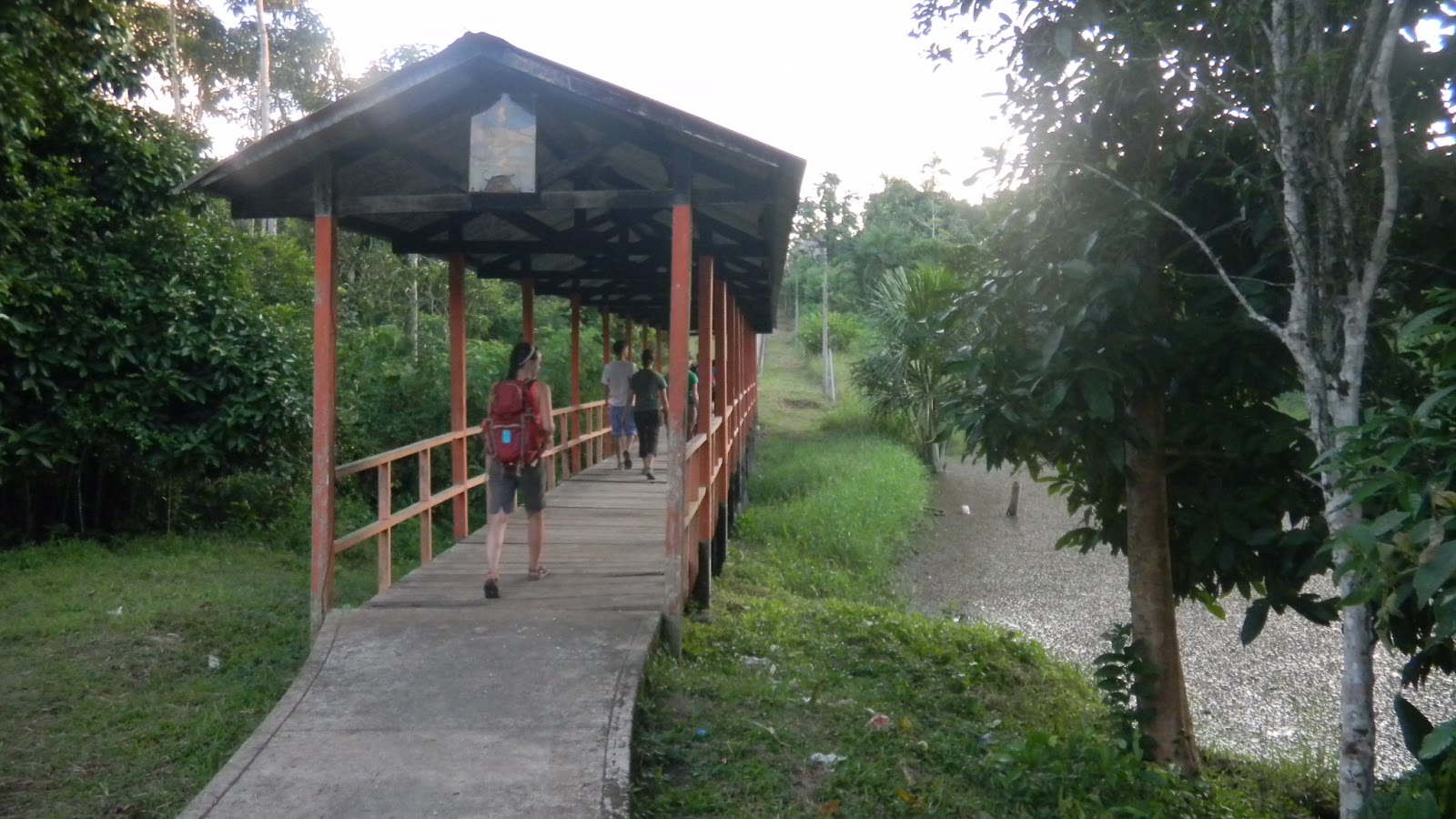
The general infrastructure is practically non-existent, however, each village has a ‘chief’ or mayor that is in charge which provides some sense of communal direction.  The rural villages aren’t usually large enough to have roads or bridges or anything, but many do have cement walkways which were funded by the Peruvian government as part of an initiative to develop the jungle.  When you get to larger jungle cities like Nauta or Iquitos there are paved roads, dirt roads, wood and metal bridges, cars and mototaxis, and Iquitos even has an airport which was previously used by the Peruvian military.  Only in really large jungle villages there is likely to be a single building with plumbing of some sort, but generally, they don’t have running water or sewage and just use river water and a latrine.  In Iquitos and Nauta there is plumbing, but the standards are very low in comparison to American plumbing standards.  The same goes for electricity.  In the rural jungle, the government has funded the strategic placement of lights and generators, but because of funds, the villages are only able to use the electric on a very minimal basis (ie: at night for an hour or so).  Iquitos and Nauta have electricity and even have energy generating electric plants powered mostly by burning wood from the surrounding rainforest. 


The medical infrastructure in the jungle is virtually non-existent except for a select few international, non-profit organizations.  In a region of a poor country where disease, parasites, malnutrition, rampant tooth decay, and premature death are normalcy, medical care is a true necessity.  Children are who suffer the most and many are left alone to survive on the streets or in the jungle with no parent or family unit to provide care.  Many countries have healthcare workers that man health posts, but in the Peruvian jungle, such government-run health posts are run much like their rural school systems; there is a physical building, but the people are rarely there, medical supplies are largely not stocked, and people’s limited healthcare knowledge prevents a belief in medicine and encourages their beliefs in “curses.”  Larger cities like Iquitos are the only places in the jungle that have actual hospitals and reliable doctors with stocked medications and vaccinations.  However, from the experience of a past team member, the hospital in Iquitos doesn't even have running water which is a major public health concern.


The ultimate goal for the region is really to shift their focus from living traditionally to living sustainably so they can ultimately provide for themselves and meet their own needs.  This is where the church comes in.  Planting the seeds of spiritual growth is a foundational part of church focus.  Healing, teaching, feeding, and loving the people of Peru are the fertilizers for the seeds of spiritual growth.  All of the help given may make a difference for a lifetime and may impact thousands on a humanitarian level, but the power of God makes a difference that will reach into eternity.


Saturday, January 26, 2013

Summer Trip Details


Who are we and what are we going to be doing?
This summer, I am joining a Medical Missions team to the Amazon Jungle of Peru through Global Partners, the missions arm of the Wesleyan church.  Although part of me is really interested in sustainability of healthcare, this trip is really centered on meeting the more immediate health needs of the Amazonian indigenous peoples.  Because our focus is on immediate needs, we are going to be holding medical clinics in several rural villages along the Amazon.  The team is comprised of an interdisciplinary team of dentists, doctors, nurse practitioners, nurses, public health students, EMTs, and students.  Because I am getting my Masters degree in Public Health with a concentration in Global Health, as part of my schooling I am going to be collecting some research data regarding gastrointestinal (GI) parasites which can be used in the future to make these short term medical trips more holistic and sustainable.

What is the clinic set up?
We have 5 stations in each of our clinics, a triage station, pharmacy station, dentist station, medical station, and a Gospel station.  The triage station is where the GI parasite data will be collected as well as the gathering of basic medical information for use by the clinicians.  The pharmacy station is where all the medications we bring with us are set up, organized, and dispensed.  The dentist station is where dental work is done, because hygiene is virtually nonexistent, we mostly just pull rotting teeth rather than doing other dental work.  The medical station is where the doctors and nurse practitioners will be treating physical needs and prescribing necessary medications.  The Gospel station is really the most important.  Providing free healthcare functions not only as an inlet for the missionaries to make first introductions and begin building relationships with people in villages, but functions as an act of goodwill that begins to build trust with the people there.  Those relationships turn into life-changing conversations, new believers, and the seeds of new churches springing up all throughout the rainforest!

St. Francis of Assisi said, “Always preach the Gospel; when necessary use words.”  By caring for the physical needs of people, the love and compassion of God is made manifest in places where the name of Jesus has never before been heard.  The full-time Global Partners missionaries in the Amazon Rainforest accompany our team into every village talk with people as they wait in line to be seen in clinic.  Each and every person that comes through the door is prayed for by the missionary by and receives a Bible in their language.

What are our methods of travel?

Of course to get to Peru we are going by airplane to the country’s capital of Lima.  While in Lima we travel by Flipper bus.  Because we are traveling to the jungle which is located in the northeast of the country and Lima is on the central coast, we will also go by airplane to the largest jungle city of Iquitos.  Throughout the city of Iquitos we travel by mototaxi which is like a converted motorcycle with a covered seat - these are much like the Thai Tuk-Tuks and were originally shipped to the Peruvian jungle from India.  To get to the villages we go by large boat and canoe-like boats with motors.  Everywhere we are we tend to do a lot of walking which is pretty fun in the cities especially.  In 2011 I led a team to the same area in August which was during the dry season, and when we went to one of the villages we had to hike about an hour through the jungle to get there which was awesome; we were able to see a lot of Peru that most travelers don’t get to see.


How do we bathe, eat, and sleep?

We usually set a base camp in one of the villages so we don’t have to take all of our stuff with us everywhere.  We take a bigger boat from Iquitos to get to the base camp, and then to get to all of the other smaller villages we take the smaller boats.  In that base camp, we sleep in army hammocks which are hammocks that have netting built in to prevent mosquitos from getting in.  That is sometimes a challenge because we Americans are heavy so ally of us hanging could make the small, poorly built houses fall down.  Sometimes we use blow-up mattresses on the ground, so we partially hang and partially lay on the ground.  It sounds really uncomfortable, but its actually not all that bad.  The heat in the middle of the night is the worst part about it - I've never sweat so much as I do in Peru.  We also bathe in the Amazon River where the natives also bathe – in safe areas hopefully free from piranhas and other dangerous animals.   The river isn't all that clean, but it isn't any different than swimming in any lake in the US - other than the possible dangerous animals of course.  Every trip we go on we bring a couple of cooks with us, who are associated with the Wesleyan church in Iquitos, along with several live chickens.  There is nothing like eating foods that are normally eaten in Peru like fresh fried chicken, plantains, yucca, and local fruits.


Where do we go to the bathroom?
In Lima and Iquitos they have indoor plumbing and have normal bathrooms.  They might not be as fancy as you are used to in the States, but they are very nice in comparison to what you get in the jungle.  One strange thing that you have to keep in mind is that many of the houses in Iquitos have a delicate plumbing system with small pipes so when you go to the bathroom you have to throw the toilet paper in the trash can.  Yeah that really does get pretty disgusting.  Just make sure that you don't throw away anything that you didn't mean to because you aren't going to want to put your hand into the trash.  In the jungle, most of the villages have at least one latrine or outhouse that is basically just a toilet bowl and a barrel of river water to 'flush' with.  Most of the village people don't use the outhouse though, they just go in the jungle which is why parasites from the fecal-oral contraction are a problem.


Why do this?
There is nothing like helping people, especially using your talents.  It takes a lot to live in the jungle, sleeping in hammocks, and bathing in the Amazon River, but helping people and meeting some of their basic needs makes it worthwhile.  It is hard to see children malnourished or with medical problems, and just being able to put a smile on their face rocks your world.  I recommend this to anyone to get out of their comfort zone and do something for others.  It is also a way of sharing the Gospel using your whole self instead of just your voice.  When there is a cultural barrier and a language barrier, sharing Christ using your actions and your heart is an unbelievable spiritual journey.

Wednesday, January 23, 2013

Planning A Trip


Planning a trip all starts with figuring out what you want to do.  Do you want to go sightseeing?  Do you want to visit popular destinations?  Do you want to volunteer?  Do you want to teach English?  Do you want to do Medical Missions?

Some of the most popular destinations in Peru are some great natural wonders of the world.  Almost any city in Peru is packed with adventurous destinations and historical sites, but probably the best place to start is in the country’s capital city of Lima which is a historical center with beautiful colonial constructions, the best museums, archeological places, as well as a host of luxury hotels and restaurants.  Huacachina is an oasis town that is surrounded by sand dunes, known for the opportunity to sand board and take dune buggy rides.  Chan Chan is an ancient city built by the Chimu around 850 AD.  Manorca has one of Peru’s best beaches and is a popular surfing destination with a great nightlife and a whole host of luxury restaurants and resorts.  Iquitos is the largest jungle city located off of the Amazon River which is a great starting point for boat tours to see some of the best and rarely seen flora and fauna of the world.  The Nazca Lines are located between Nazca and Palpa along the northern Pacific coast, and are figures of monkeys, fish, spiders, llamas, and human figures created on a large scale that can be seen via air.  Santa Catalina Monastery is located in Arequipa and is one of the most important monasteries of colonial Peru and Latin America.  The Uros Islands are artificial islands made of dried totora reeds on Lake Titicaca which is also a top tourist attraction.  Plaza de Armas is a plaza built by the Incas in Cuzco and is known as the “square of the warrior.”  There are awesome sights in the Colca Canyon in the Andes mountain range in southern Peru which is a canyon more than twice as deep as the Grand Canyon.  The most visited and one of the most beautiful of the ancient sites in the world, however, is Machu Picchu which is the “Lost city of the Incas” that is located on the slopes of the Andes.  

  
Specifically I am involved with Medical Missions that is through an organization called GlobalPartners which is the missions arm of the Wesleyan church.  I am not Wesleyan, but I went to Indiana Wesleyan University for my undergrad, and went on a trip through the school.  If you want to go a Medical Missions trip there are several organizations that do so in Peru.  There is Handsof Hope, Doctors Without Borders, International Medical Relief, AyacuchoMission, Operation Smile, Cross-Cultural Solutions, along with many others. 

After determining when you want to go, what it is that you want to do, what organization you want to go with (if any), it is time to get organized.  You need to purchase plane tickets, plan in country travel (whether it is taxi, moto taxi, or boat), get hotel accommodations, and purchase any other needed tickets.  What I mean by purchasing other needed tickets, in Macchu Picchu for instance, they only allow so many people to visit per day so tickets are needed.

Now you are set to go on your trip!  See my future post on details on packing for a trip.

Monday, January 21, 2013

Peruvian Food


Lifestyles are always dependent on social class in developing countries.  People in lower classes usually work several jobs, live in the outskirts of cities, and eat basic foods.  The upper class usually have more leisurely lifestyles, they work in the morning, have a traditional main afternoon meal, and a siesta; afterward they either return to work, hang out with friends, watch soap operas, or play sports.

The food in Peru is directly influenced by the multitude of cultural influences from immigrants.  There are a lot of Chinese influences in Peru, and there are a ton of ‘chifas’ or Chinese restaurants.  Be careful on the ones you select, however, food sanitation is not always present. The Chinese modified their cuisine and incorporated many Peruvian elements (mainly Spanish, native and African) into their cuisine.


The three traditional staples of Peruvian cuisine are corn, potatoes, and chili peppers.  Peru has 3800 different types of potatoes which is why it is considered the birth place of the potato in South America.  They differ in size, shape, color, skin, pulp, texture and of course in their taste.  However, all types have their place in the Peruvian cuisine.  The word "papa" is originally Quechua and simply means tuber, and in Spanish it means potato.


Casava or yucca is common as is the plantain.  I love both of them, they are two of my favorites. Fried yucca and fried plantain chips are amazing! 


 Of course because Peru is a tropical country, a variety of fruits grow naturally.  Native fruits include lucuma, camu camu, prickly pear, cape gooseberry, cocona, pacay (technically a legume but used as a fruit), guanabana, dragon fruit, pepino, papaya, ciruela, mammee apple, banana, passionfruit, cherimoya, granadilla, moriche palm fruit, and tamarillo.  A couple of my favorites are the lucuma, camu camu, and guanabana.  Stay away from the cherimoya, its gross.  In the city of Iquitos there are several ice cream shops that have ice cream flavors with native fruit flavors.


Ceviche is a South American dish of marinated raw fish or seafood, typically garnished with herbs and served as an appetizer.  Tiradito is a related dish that shows the influence of Japanese immigrants and sashimi techniques.  Regarded as typical from Arequipa, Chupe de Camarones is regularly found in Peruvian restaurants specialized in Arequipan cuisine.  It is made from a thick freshwater shrimp (crayfish) stock soup, potatoes, milk and chili pepper.


There are many popular and delicious Peruvian dishes.  Pollo a la Brasa or grilled chicken is one of the most consumed foods in the country.  It is delicious, especially at Pardos restaurant in Lima.  Cow heart (anticuchos) is also delicious and you can get it at Pardos; it tastes like steak.  Arroz con Pollo is one of my favorite Peruvian dishes which is simply Peruvian yellow rice and roasted chicken.  

In the jungle there are various animal species that are hunted for food that you cannot find elsewhere in the world.  Some of the standouts include paiche (one of the world’s largest freshwater fish), and many other types of fish like gamitana, sabalo, tucunare, boquichico, palometa, bagre, and piranha, that are prepared in variety of dishes.  Other standouts are motelo (land turtle), and the charapa and taricaya (river turtles).  Other random foods that I have tried include alligator, monkey, jungle toad, Cuy (guinea pig), and Capybara (one of the world’s largest rodents).


 Peruvian desserts that are delicious include alfajores which is two cookies with dulce de leche in the middle.  Lúcuma juice, ice cream, and corresponding lúcuma shakes are very popular throughout Peru.  Arroz con Leche (rice-pudding) is one of the more common desserts found in homes and restaurants of modern-day Peru that consists primarily of cooked rice, cinnamon/nutmeg, raisins, and milk.  Of course there are also numerous flavors of helado or ice cream, especially in native fruit flavors which are delicious!


 Beverages that are common include my favorite drink Inca Kola which is the national beverage of Peru which is a lemon grass flavored soda that tastes a little bit like cotton candy.  It sounds gross, but it is actually delicious, I always bring home a couple liters whenever I go to Peru; it can only be found in national markets and select Peruvian restaurants in the states.  It is usually offered alongside Coca Cola at most restaurants.  One thing to beware of is water, make sure not to get any water that is not in a bottle, and also be weary of ice cubes – parasites like giardia are common to travelers, even in nice restaurants.  In the jungle, try the refrescos which are juices mixed with water and sugar.  In the jungle city of Iquitos at Ari Burger, the best restaurant in the city, they sell refrescos made with many different local fruits like lucuma and guanabana.  Chicha morada is also a common beverage that you will see in Peru.  It is made when purple corn (maíz morado) that only grows in Peru is boiled along with cinnamon and cloves. When the water cools, chopped fruit, key lime and sugar are added.  It is pretty tasty and the kids love it, it is the Peruvian version of Kool-Aid.


A traditional alcoholic beverage throughout the Amazon Basin is called chichi.  It is made most often with cassava root and sometimes plantain.  Traditionally, the chicha is prepared from cassava root by women, using a very simple method.  Pieces of washed, peeled root are thoroughly chewed in the mouth, and the resulting juice is spat into a bowl.  The bowl is set aside for a few hours to allow the juice to ferment.  This chicha is a somewhat opaque blue white, similar in appearance to defatted milk, and its flavor is mildly sweet and sour.  Cassava root is very starchy, and enzymes in the preparer's saliva rapidly convert the starch to simple sugar, which is converted by wild yeast and/or bacteria into alcohol.  In the amazon of Peru it is usually called masato and is traditionally offered to arriving guests.  I have never tried this nor ever would want to.  I would suggest that travelers avoid this as parasite transmission would be likely due to its minimal alcohol content and preparation process.


Monday, January 14, 2013

A Little Peruvian History


Peru is a South American country that is bordered by Ecuador and Colombia in the north, east by Brazil, and south by Bolivia and Chile.  Before being settled by Francisco Pizarro and other Spanish settlers in the early 16th century, the country was home to some of the oldest untouched ancient civilizations.  The Incan Empire occupied much of the South American countries surrounding the Andean mountain ranges, although much of its history can be seen in Peru.  Remains can be seen in Cuzco and most notably at Machu Picchu and the Nazca Lines, highlighting their ingenious knowledge of infrastructure, spirituality, and the sciences.


 Peru is what is called a representative democratic republic which has elements of both the parliamentary and presidential system of government, and is divided into 25 regions.  The country’s capital is in Lima which is on the southern coast is the most developed.  It is a beautiful city with a lot of history, and a lot of tourist attractions.  Even with such beauty, poverty can be seen on the mountainside in shanty towns.  It is estimated that the Peruvian poor that live in the urban environment have a 20% higher mortality rate.  The Lima shanty towns are rampant with cocaine and the cheaper alternative of base cocaine, and diseases there spread like wildfire.


The most notable region to me is the Loreto region, or the jungle region which containing a large portion of the Amazon basin.  This is a mostly unsettled region of the country where Iquitos, the largest jungle city, and the sixth largest city in the country.  It is nicknamed the ‘Capital of the Peruvian Amazon.’  The most notable thing about the city is that it is the largest city in the world which cannot be reached by road, only airplane or boat.  There is one road to the small town of Nauta, which is about 60 miles south.  Let me tell you, that road cannot be considered a road in American standards.  It is very rocky, hilly, and dusty, which makes carsickness common.  Yeah, not all that fun when there is a small bus packed full, hip to hip, with people.  There aren't many cars in Iquitos because of the expense of shipping them there, but they mostly use moto-taxis which are motorcycles with carts built on the back.  These are fun, but very dangerous.


Peru is considered a developing country meaning that it is relatively poor.  And it is a melting pot of ethnicities.  The first time I went to Peru I was confused because there is a ‘Chifa’ or Chinese restaurant on every street corner.  The high prevalence of ethnic groups is because they were shipped in during the rubber boom to chop down trees and work the silver and copper mines.  The major economic activities include agriculture, fishing, mining, and textiles.  Most of the men in the jungle do a lot of logging which contributes largely to the destruction of the Peruvian jungle.  Another thing that led to destruction of the jungle started during the rubber boom, the Amazon was one place natural rubber grew. 


Peru is 496, 225 square miles of beauty.  It contains the Andean mountain region which defines the regions of coastal, mountain, and jungle.  This is what gives the country varying climates which varies from tropical in the jungle to desert in the west. 

The official languages include Spanish and Quechua.  Quechua is more of a jungle language and one that was spoken by the ancient Incas.  There are also a variety of other jungle and rural languages that are spoken. 


Ok that is about all the information that I could quickly put together into one post.  Stay tuned for more information about the people, travels, and research.